Fish Emulsion and Seaweed Extract
Melissa Ann Pline Brown, Former Graduate Student, and Jeanine Davis, Ph.D., Advisor Department of Horticultural Science NC State University
4/29/2022 - Please note: this was part of a Master's thesis project completed in 2004. It has not been updated. Access the thesis.
Snake Oil or Supplemental Fertilizer?Product claims:
|
Fish emulsions: 2-4-1 and Ca, Mg, S, Cl, and Na
Seaweed extracts: 0-0-1 and minor nutrients
Fish/Seaweed blends: 2-3-1
|
Germination
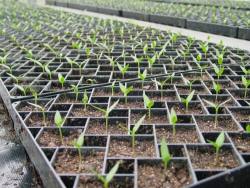
To investigate the claim that soaking seeds in sea products will increase seed germination, a germination study was conducted. Pepper and tomato seeds were soaked overnight in fish, seaweed, fish/seaweed, or water. As a control, some seeds were not soaked. There was no difference in germination rates between any of the treatments.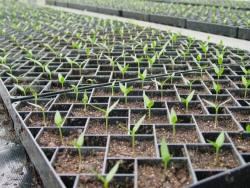
Transplant Production
Fish and seaweed products are commonly used as source of fertility in the production of organic transplants. Greenhouse studies were conducted to determine the optimal number of applications. Tomato and pepper transplants were grown in Winstrip flats and drenched with 1/2 oz/gallon of seaweed/fish either bi-weekly, weekly, or two times weekly. The controls received no applications. The preliminary studies showed the plants with the greatest heights and weights were those receiving the solution twice a week.spraying plantsFoliar Fertilization
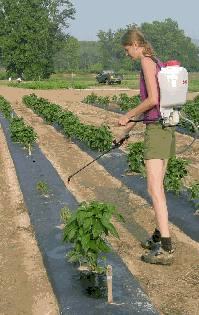
Foliar fertilization is the application, via spraying, of nutrients to plant leaves and stems where they are absorbed into the plant through the cuticle. Greenhouse and field studies were conducted on sweet peppers. The peppers were sprayed bi-weekly with 1 oz/gallon of fish, seaweed, fish/seaweed, 20-20-20, or water. The field peppers with sprayed with a solar backpack until the liquid flowed off the leaves. Ratings and heights were taken weekly and peppers were harvested bi-weekly. After one harvest from the field, there were no significant differences in yield and grade of sweet peppers.